4 Witnesses from Christian Tradition
Over the centuries, a number of figures from Christian tradition left behind a record of a close relationship with animals — birds, bears, horses, and, in particular, dogs. This chapter gathers ten of them, always distinguishing documented history from later tradition. It is not a theological argument: it is an invitation to encounter these lives and texts, and, through them, perhaps to see the animals who share our daily lives a little differently.
4.1 Francis of Assisi
c. 1181–1226 · Italy · founder of the Franciscan order
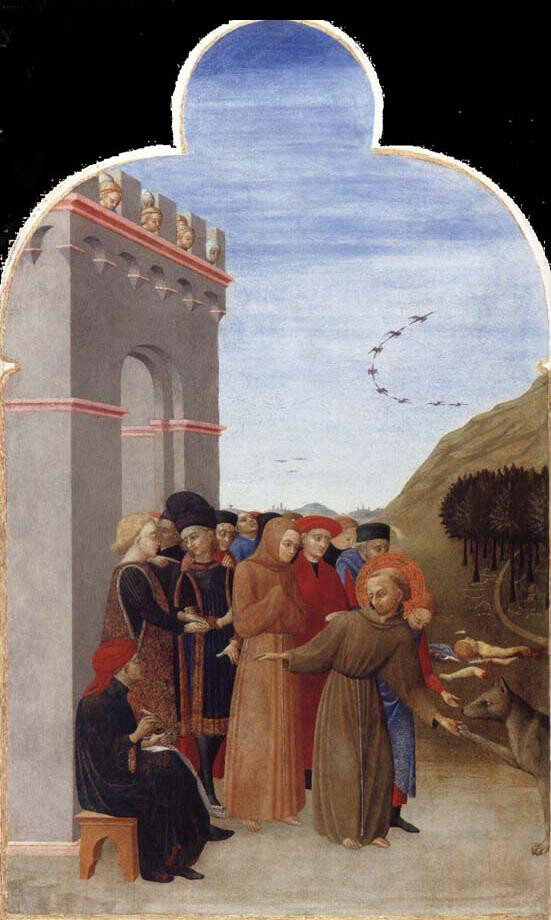
Francis’s own words about creation survive directly: the Canticle of the Creatures, composed around 1225, calls the sun and wind “brother” and the moon, water, and earth “sister,” placing every created thing in one family (Francis of Assisi 1906). In his own medieval Umbrian:
“Laudato si’, mi’ Signore, cum tucte le tue creature.”
— praised be You, my Lord, with all your creatures (translation ours) (Francis of Assisi 1906).
A later tradition — set down nearly a century afterward in the Fioretti (“Little Flowers of St. Francis”), and absent from the saint’s official biography — tells how Francis went to meet a wolf, a wild relative of the dog, that had been terrorizing the town of Gubbio, and won from it a promise of peace with the townspeople in exchange for being fed. It is a lovely, much-retold story; it belongs to tradition, not to verified history (The Little Flowers of St. Francis (i Fioretti), Ch. XXI, n.d.; Wikipedia contributors 2026f; The Wolf of Gubbio 2025).
4.2 Roch of Montpellier
traditional dates c. 1295–1327, uncertain · France and Italy
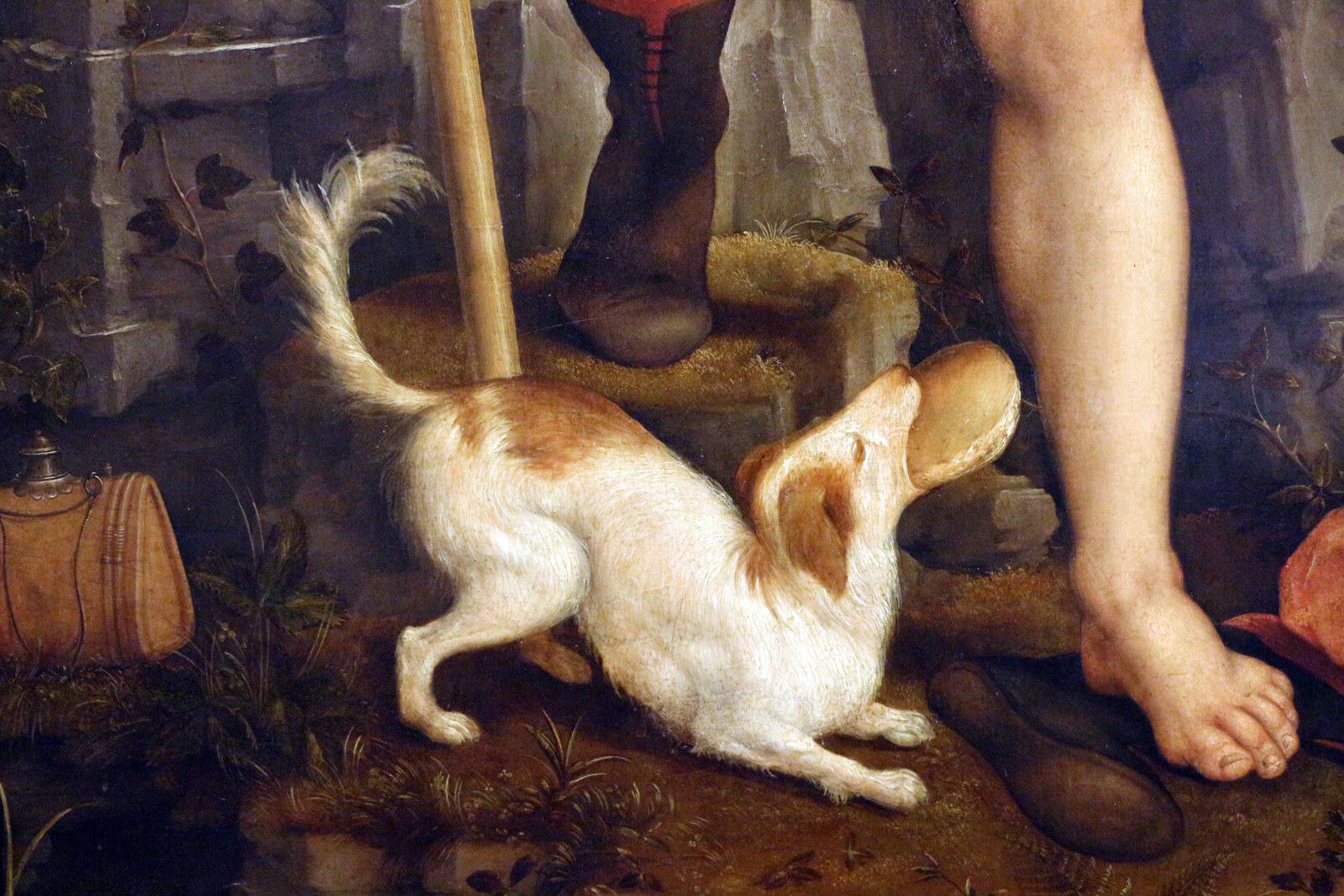
Roch’s life is known mostly through late hagiographies, with few verifiable facts: he is known to have worked through plague hospitals in several Italian cities, and his cult grew sharply after the 1477–79 plague (Wikipedia contributors 2026e). Tradition holds that, falling ill himself, he withdrew into a forest, and that a dog belonging to a local nobleman brought him bread every day and licked his wound, keeping him alive until he was found. It is why Roch is still invoked today as patron of dogs — one of the most direct saint-and-dog associations in the whole of Christian tradition, even though, like almost everything else in his life, it is tradition rather than historical record (Wikipedia contributors 2026e).
4.3 Hubert of Liège
c. 656–727 · Frankish Ardennes · bishop of Maastricht and Liège
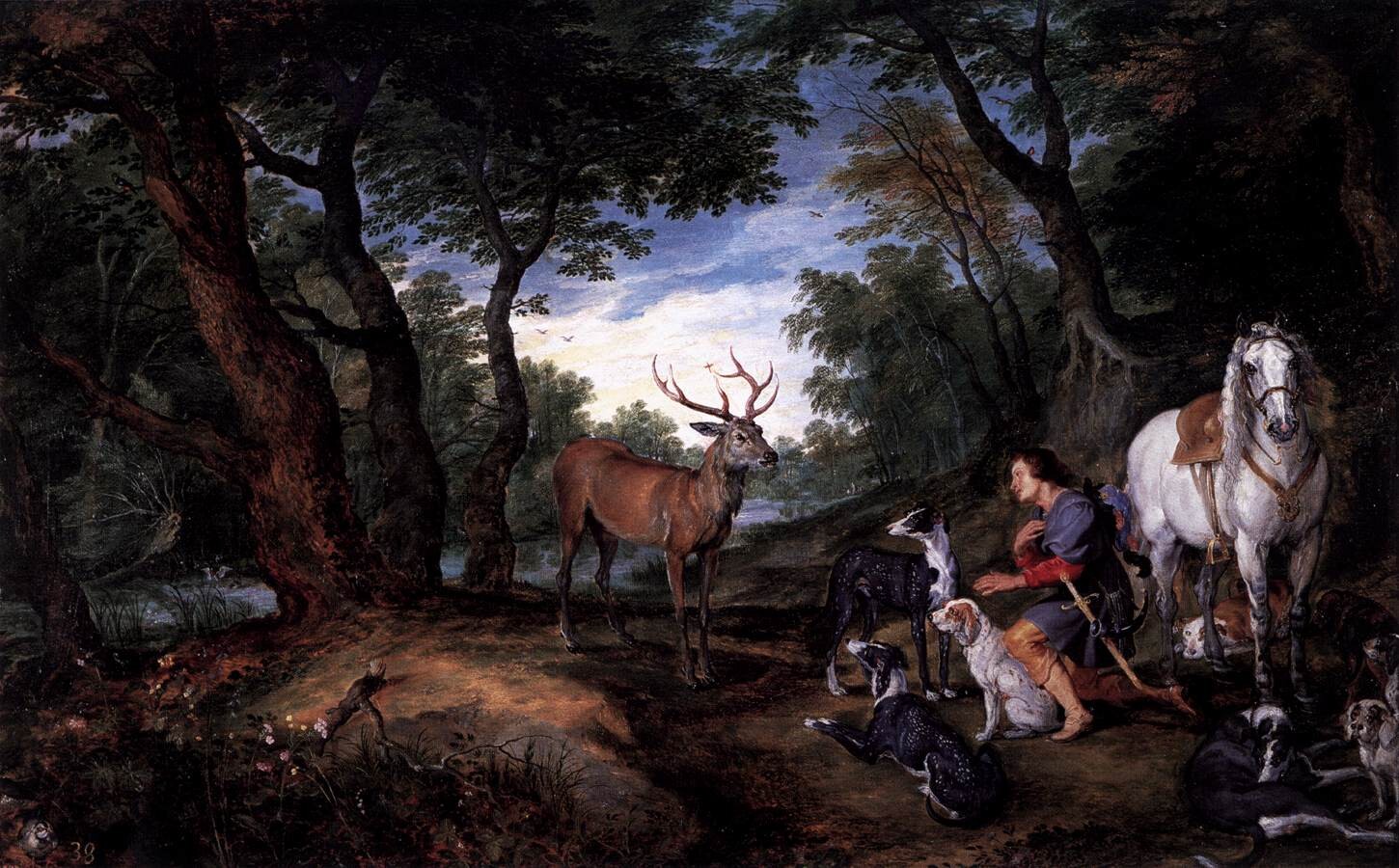
Hubert was a historically documented bishop who died in 727 and was buried at the Benedictine abbey in the Belgian Ardennes that now bears his name (Wikipedia contributors 2026c). The best-known legend — that, hunting on Good Friday, he saw a glowing cross between a stag’s antlers, and that the encounter turned him to conversion — is a later addition, absent from any record close to his life.
What is history, not legend, is what happened afterward: the monks of the Abbey of Saint-Hubert bred a keen-scented hunting hound in his honour — the chien de Saint-Hubert — which they sent as an annual tribute to the King of France, and which is recognized today as the direct ancestor of the Bloodhound. Few saints have such a concrete, verifiable link to a dog breed that still exists (Wikipedia contributors 2026a, 2026b; St. Hubert’s Hound, n.d.).
4.4 Anthony the Great
c. 251–356 · Egypt · father of Christian monasticism
Anthony’s life is known through a near-contemporary text: the Life of Antony, written by Athanasius of Alexandria shortly after his death, by someone who had known him. It describes the twenty years Anthony spent alone in an abandoned desert fort, surrounded by wild animals — jackals, snakes — without harming them or being harmed by them: a sign, for Athanasius, of an inner peace that extended to the creation around him (Athanasius of Alexandria 1892).
4.5 Cuthbert of Lindisfarne
c. 634–687 · Northumbria
Cuthbert, too, is known through an account close to his life: the Life of Cuthbert, written by the Venerable Bede about thirty years after his death, drawing on people who had known him. He is said to have prayed standing all night in the cold sea, after which two otters came up and dried and warmed his feet with their fur before leaving with his blessing. Cuthbert is also remembered for establishing, around 676, one of the earliest recorded bird-protection laws in Europe, to protect the eider ducks nesting on the Farne Islands — still known locally today as “Cuddy’s ducks” (How a Catholic Monk Created One of the First Ever Bird Protection Laws, n.d.; St Cuthbert’s Ducks, n.d.).
4.6 Kevin of Glendalough
c. 498–618 · Ireland
According to tradition recorded in the Vita Sancti Coemgeni, written some five hundred years after his death, a blackbird once landed in Kevin’s open hand while he prayed, and built its nest there. Tradition holds that Kevin kept his arm still through the whole nesting season, until the chicks had fledged — an image that has carried through the centuries as a picture of patience and attentiveness to the smallest creatures (Wikipedia contributors 2026d; "The Boy with the Blackbird in His Hand" (Saint Kevin of Glendalough), n.d.).
4.7 Seraphim of Sarov
1754–1833 · Russia
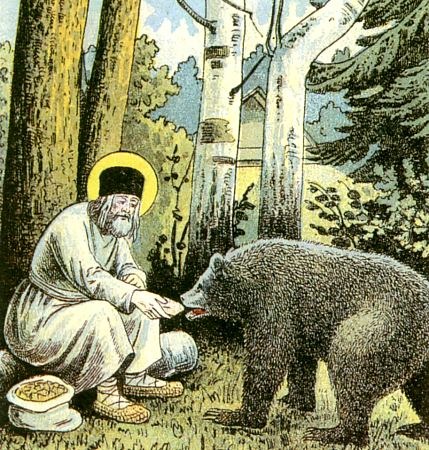
Unlike the medieval legends above, the best-known episode of Seraphim’s relationship with animals has direct witnesses: nuns from the nearby Diveyevo convent and a fellow monk, Father Joseph, left written accounts, still in the 19th century, of a bear that regularly visited Seraphim’s forest hermitage and that he fed by hand, without fear. The accounts are not a critical edition of primary sources, but they converge consistently, coming from several people who knew him (St. Seraphim of Sarov and the Bear “Misha” 2021; St Seraphim and the Bear 2004).
4.8 Martin de Porres
1579–1639 · Peru · Dominican lay brother
Martin, put in charge of the infirmary at the Dominican convent of the Rosary in Lima, is consistently remembered, in biographical sources and in his canonization process, for his care of sick or stray animals — dogs, cats, even mice he refused to have poisoned. The traditional image of him with a dog, a cat, and a mouse eating peacefully from the same dish sums up that care: not a one-off exception, but a pattern of life (Martin de Porres, n.d.; St. Martin de Porres, n.d.).
4.9 Columba of Iona
c. 521–597 · Ireland and Scotland
Adomnán, ninth abbot of Iona, wrote the Life of Columba about a century after his death, drawing on the written and oral memory of the community Columba himself had founded. Near the end of Columba’s life, an old horse that had carried the monastery’s milk pails for years came up to him, laid its head on his chest and, according to Adomnán, wept. When a monk tried to lead the animal away, Columba stopped him, saying that the Creator had revealed to the horse, in his own way, that its master was about to leave (Adomnán of Iona 1857).
4.10 Modestus of Jerusalem
d. 634 · Patriarch of Jerusalem
Modestus was a historically documented Patriarch of Jerusalem, who rebuilt churches there after the Persian sack of 614. His veneration as a protector of domestic animals, and the prayer still said in his name in Greek and Cypriot Orthodox tradition — asking for the health of the animals families depended on — is a later devotional tradition: its authorship by Modestus is attributed, not confirmed by any 7th-century document. Even so, it remains, thirteen centuries on, one of the rare examples of a Christian prayer devoted specifically to the well-being of animals (Sanidopoulos 2015).
A note on dog behaviour
The stories above show dogs as companions, protectors, and instruments of care. It is worth remembering that a dog’s behaviour is shaped, above all, by experience, environment, and the human care it receives. An aggressive dog carries no moral stain, and it proves nothing about dogs being impure or dangerous by nature — it is behaviour, with causes, not a fate.